2025-2026 Graduate Catalog [ARCHIVED CATALOG]
Geography and Geospatial Sciences
|
|
Marcellus M. Caldas, Interim Department Head
Audrey Joslin, Graduate program director
1002 Seaton Hall
785-532-6727
Fax: 785-532-7310
ajoslin@k-state.edu
http://www.ksu.edu/geography
Overview
The Department of Geography and Geospatial Sciences graduate program at Kansas State University offers a Master of Science (MS) degree and a Philosophy (PhD) degree in Geography. Discovery and dissemination of new knowledge are the cornerstones of our mission. Drawing upon the research interests and experience of the faculty, the department’s core areas of geographic inquiry are illustrated in the figure below. Much of the research conducted by faculty and graduate students incorporates more than one of these themes, and we accomplish these research activities in an atmosphere of open inquiry and academic freedom.
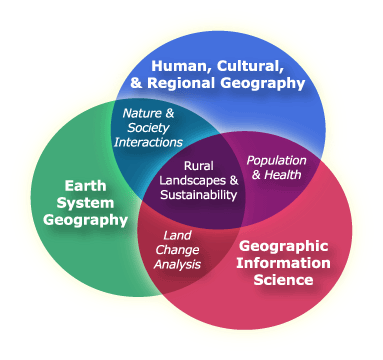
The department’s research mission incorporates studies that reinforce the land-grant mandate of the institution, including agricultural water management and rural community development, examination of the role on climatic variability on Great Plains ecosystems, and assessment of changes in stream systems and reservoirs related to human activity. Research themes include:
- Research into human spatial behavior, regional and place identity, and the relationship between humans and the environment, such as societal adjustments to floods, population redistribution in the Great Plains, cultural, social, and ethnic change in the landscape, and assessments of migration decisions associated with residential satisfaction;
- Examination of the applicability of new geographic knowledge and the emerging technologies associated with computer cartography, geographic information systems, and remote sensing; and
- A symbiotic relationship among discovery of new knowledge, graduate and undergraduate education, and improvement in the quality of life through research application to societal issues.
In accomplishing the University’s instructional mission, we stress quality teaching and advising and strive to provide all students with opportunities to develop the knowledge, understanding, and skills characteristic of an educated person. Our contributions include:
- Providing undergraduate and graduate students with a thorough grounding in the discipline of geography from a liberal arts perspective;
- Teaching service courses that provide students with an opportunity to meet a number of either general education or college distribution requirements with classes and seminars that deal with international awareness, social and cultural diversity, and human interactions with the physical environment;
- Preparing students to better appreciate local, regional, and global affairs by promoting attainment of knowledge and modes of thought that will help individuals make meaningful lifetime decisions;
- Educating students so that they are successful in either further academic study or professional employment;
- Offering extracurricular learning experiences, including geographically oriented internships and seminars by internationally renowned geographic scholars, that promote academic excellence and cultural diversity; and
- Using educational approaches that permit the communication and application of basic geographic concepts and techniques that have broad implications for other disciplines.
The benefits of the graduate program at K-State include a balanced curriculum and a commitment to a broad-based approach to geographic research and scholarship. The moderate size of the department fosters an informal, friendly atmosphere with the opportunity to work closely with faculty. Teams of students and faculty frequently collaborate on research and publications. A graduate certificate in GIScience is also available, which can be earned as a stand-alone certificate or in conjunction with a master’s or doctoral degree.
The department is centrally located on campus in Seaton Hall near the libraries, most classrooms, and the Student Union. Departmental resources include the Geographic Information Systems/Spatial Analysis Laboratory (GISSAL) for geospatial analysis, the Remote Sensing Research Lab, with capability for collection and analysis of imagery and proximal remote sensing data, the Paleoenvironment Lab, with a full suite of instrumentation for sediment and pollen analysis, The Soil-Geomorphology lab, equipped to characterize pedogenic and geomorphic processes, and the Geospatial Teaching Lab, equipped for interactive and distance teaching across the range of GIScience. Software resources for research and teaching include a campus site license from ESRI and a range of widely used statistical and remote sensing programs.
Admission procedures and requirements
For complete information on how to apply to a geography graduate program, visit the Department of Geography and Geospatial Sciences.
Regular admission to the Graduate School and the Department of Geography and Geospatial Sciences requires a 3.0 grade point average on a 4.0 scale, three letters of recommendation, official transcripts, and a one- to two-page statement of interests and objectives. Admission to the graduate program is contingent upon the willingness of a geography faculty member to serve as the student’s advisor. The Graduate Program Committee, currently consisting of Drs. Audrey Joslin (director), Langston, Smirnova, and Lu, administers the admissions process. Ph.D. students who have not completed the master’s degree by the end of their first semester in the Ph.D. program are subject to dismissal. In some cases, applicants with less than a 3.0 grade point average may be admitted to the M.A. program on a probationary basis.
For non-degree applicants the Department of Geography and Geospatial Sciences requires official transcripts, a one- to two-page statement of interests and objectives, and two letters of recommendation.
Student applicants should Graduate School application deadlines, which are usually earlier for international students. The faculty contact for questions about admission is Dr. Audrey Joslin (ajoslin@ksu.edu).
Financial support
Several positions as a Graduate Teaching Assistant (GTA) or Graduate Research Assistant (GRA) are available each year on a competitive basis for nine-month appointments; some support may also be available for summer months. Full-time GTAs receive a stipend, a full tuition waiver and a start-of-year Steve R. Kale scholarship. GRAs, supported from geography faculty research grants, receive a stipend, tuition support, and a tuition reduction from out-of-state to in-state rates. A limited number of competitive Timothy R. Donoghue Scholarships may also be available from the Graduate School to enhance graduate stipends; the Department of Geography applies for these on behalf of qualified students.
Graduate assistantships are generally awarded for two years for M.A. students and three years for Ph.D. students, contingent upon satisfactory performance of the GTA or GRA duties and academic progress, including the achievement of a minimum cumulative 3.33 grade point average in graduate studies at Kansas State University. Doctoral students may be eligible for a fourth year of GTA funding, depending on the needs and resources of the department and their performance. For a student to receive a fourth year of GTA funding the student must have demonstrated good departmental citizenship and high-quality teaching. The student must also have achieved PhD Candidacy by passing the preliminary examination and presenting an acceptable dissertation proposal before February 1 of the student’s third academic year.
Graduate Teaching Assistant Guidelines:
- GTA assignments are made by the Department Head in consultation with the Graduate Program Committee and faculty. Tasks generally include teaching lecture or lab sections, or providing assistance for faculty who are teaching large enrollment classes, such as proctoring exams, developing class resources, and other tasks. Most GTAs hold 9-month .5 FTE appointments; this requires 20 hours/week of GTA work during the fall and spring semesters.
Graduate Research Assistant Guidelines:
- Responsibilities are determined by the principal investigator but generally include data analysis, report and manuscript writing, preparation of graphics for professional presentations, attending meetings on the research project, and completing hardware and software maintenance.
Career opportunities
Career opportunities in geography are diverse and employment prospects after receipt of the master’s or Ph.D. degree are excellent. Employment opportunities include positions in business, government, and education.
Federal agencies, such as the Environmental Protection Agency, National Imagery and Mapping Agency, Defense Intelligence Agency, Bureau of the Census, and Bureau of Land Management employ numerous geographers each year. State and local agencies employ geographers with specialties in many areas, including environmental geography, physical geography, health, cultural geography, planning, and spatial techniques.
The geographer’s training in location analysis, social and environmental problems, and a variety of spatial techniques including remote sensing, geographic information systems, and computer cartography, make the geographer particularly valuable in the private sector. Job titles such as geographic information systems manager, environmental planner, market researcher, and risk analyst are just a few of the varied positions held by geographers in business.
Graduates of the department have also achieved success in teaching and/or research positions at public and private educational institutions. PhD graduates of the department, for example, are employed as professors at a variety of universities, including Auburn University, Fort Hays State University, Kansas State University, Macalester College, Morehead State University, Auburn University, University of North Dakota, Saginaw Valley State University, Frostburg State University, and Jacksonville State University.
Faculty-Graduate Student Liaison
The Faculty-Graduate Student Liaison will serve a one-year term, potentially renewable, from July 1 to June 30. The Liaison will be selected by the graduate students, subject to faculty approval. The student officers of the local chapter of Gamma Theta Upsilon, the international geographical honor society, also handle some of the responsibilities listed below, thus the Liaison must coordinate the implementation of these responsibilities with GTU officers.
Responsibilities include:
- Fostering an atmosphere of collegiality and respect among all departmental citizens.
- Enhancing the communication of graduate program issues and events among the faculty, department head, graduate program director, and graduate students.
- Coordinating graduate student involvement in departmental events, such as lunches and receptions for visiting speakers, graduate school fairs, open house, and the alumni board meeting.
- Attending faculty meetings, except for closed sessions; raising issues of interest to graduate students; and communicating with graduate students about the content of these meetings.
General Requirements
Program Advising
Each new graduate student will be assigned an initial graduate advisor to assist in planning the student’s graduate program. A student may select another faculty member to become the student’s primary advisor at any time, contingent upon the willingness of the faculty member to serve as the advisor. In accordance with Graduate School regulations, a copy of the student’s Program of Study together with the names of the major professor and committee members should be filed with the Graduate School after completion of at least nine graduate hours. The program of study is typically filed in the second semester, for an MA student, and no later than the fourth semester for a doctoral student. (The terms major professor, thesis/report/dissertation supervisor, committee chair, and advisor are used interchangeably.)
The M.A. degree supervisory committee must include a minimum of three faculty members, all of whom may be geographers. The thesis supervisor is typically the graduate advisor for the duration of the program of study. The doctoral supervisory committee must include a minimum of four faculty members, one of whom must be from a department other than geography, i.e., a non-geographer. The Graduate School, based upon a request from the student’s committee chair, must approve any committee members from other universities. All members of a supervisory committee must have Graduate Faculty status at Kansas State University; for a list see: https://www.k-state.edu/geography/people/index.html.
Graduate Program Meetings
The program meeting is an evaluation of the student’s past academic experiences and discussion about the student’s program objectives. The planning meetings serve as a foundation from which to plan the program of study, obtain recommendations for course work beyond that required in the program of study, and discuss progress toward the degree and completion of the report, thesis, or dissertation. Their first semester meeting will be with the student, advisor, and any other faculty invited by the advisor. During each semester thereafter the program meeting will include the faculty on the supervisory committee. Graduate students are also required to submit an annual progress report.
Transfer Credits
The Geography and Geospatial Sciences Department may accept up to a maximum of ten credit hours of graduate credit from another university. Only courses that logically fit the student’s program of study will be accepted, based on a majority vote of the supervisory committee.
Seminars in Geography
For purposes of program requirements the following courses in geography are considered graduate level seminars. This list is subject to change. Please see your advisor for information about seminars that are likely to be offered during your semesters of residence. Seminar in Regional Geography (680), Topics in Remote Sensing (711), World Population Patterns (715), Geography of Land Use (720), Geography of Water Resources (725), World Agricultural Systems (730), Topics in Climatology (735), Urban Geography (750), Human Impact on the Environment (760), Geography of Natural Hazards (765), Perception of the Environment (770), Cultural Geography (780), Seminar in Cultural-Economic Geography (790), Rural Population Geography (815), Rural Geography (830), Rural Economic Development (835), Advanced Environmental Geography (840), Rural Cultural Geography of the U.S. (855), Rural Medical Geography (865), Western Landscapes (870), Spatial Data Analysis and Modeling (880), Advanced Spatial Analysis Techniques (890), Methods, Theory, and Models in Geography (900).
Grade Requirements
Graduate School regulations require students to 1) have a cumulative GPA of 3.0 or higher on graduate course work and on course work in the Program of Study, 2) meet all the requirements of the Graduate School, the student’s academic program area, and the student’s supervisory committee, and 3) be enrolled during the semester in which the degree requirements are completed. The Department of Geography and Geospatial Sciences requires all graduate students receiving funding as a GTA or GRA to maintain a minimum cumulative GPA of 3.33 in coursework at Kansas State University.
Credit/No Credit Grading
Graduate School regulations pertaining to the taking of courses by graduate students on a credit/no credit basis are highly restrictive. In the Geography and Geospatial Sciences Department, only the Master’s Report (GEOG 898), the Master’s Thesis (GEOG 899), and the Ph.D. Research in Geography (GEOG 999), may be taken on a credit/no credit basis. Very few courses in other departments have been similarly designated for credit/no status for graduate credit; most of the 600 and 700 level courses shown in the course schedule that are available for credit/no credit grading are so indicated only in reference to undergraduate credit. In any case, no more than three hours of such credit (excluding the Report, Thesis, or Dissertation) may appear on the program of study. Independently of the program of study, additional courses may be taken on a credit/no credit basis with the approval of the professor offering the course. These courses may not be applied toward a degree.
A/Pass/Fail
Only courses beyond those listed on the program of study may be taken on A/PASS/F basis with the approval of the major professor and the professor offering the course. These courses may not be applied toward the requirements for an MA or Ph.D. degree.
Course Load
Students should choose their course load for any given semester in consultation with their advisor. All geography graduate students in residence are required to enroll in GEOG 800 (Graduate Seminar in Geography) each semester. Graduate Teaching and Research Assistants are required by the Graduate School to carry a minimum program of 6 credit hours per semester, and those holding a 5/10 time assistantship may not take more than 10 credit hours of course work during each semester. The Geography and Geospatial Sciences Department requires that GTAs take at least six credit hours each semester in courses that are either a part of, or relevant to, the student’s program of study.
Independent Study
Graduate School regulations place a limit of 3 credit hours of independent study which may be counted as part of the hours required for the MA and 6 credit hours for the Ph.D. degree excluding, however, the thesis, dissertation, or report hours. A student’s advisor may petition the Graduate School for an exception to these limits.
Visiting Scholars
In order to broaden the graduate students’ experience with various specialties in geography, and various methodological outlooks, the Department invites four or more geographers a year to visit our community. Ordinarily, such a visit will include a public lecture, a departmental seminar, a student luncheon, and an informal evening gathering often at a faculty member’s home. Graduate students in residence are expected to attend all departmental speaker events as part of their enrollment in GEOG 800 (Graduate Seminar in Geography). In the event an unavoidable conflict arises regarding attendance at any of the scheduled events, the student should give prior notice to the advisor.
Thesis and Dissertation Proposals
Students will prepare a thesis or dissertation under the direction of a supervising faculty member. The supervisor will certify that a written proposal is acceptable for presentation to the assembled departmental faculty and graduate students. Students in the M.A. thesis option must present a thesis proposal as part of Geographic Research Methods (GEOG 821). In addition, students pursuing the non-thesis option must present a research proposal in Geographic Research Methods. The student’s desire to pursue the thesis or non-thesis option must be made known to the faculty before the presentation. Following the presentation, thesis supervisory committee will discuss with the student the necessary proposal revisions, if any, and appropriate next steps in the research. Prior to the preliminary examination, Ph.D. students will complete a written dissertation proposal and publicly present it to the supervisory committee, other faculty, and other students. An oral presentation of the proposal will be conducted before the supervisory committee, other faculty, and students.
As regular faculty carry nine-month appointments (mid-August through mid-May), there should be no expectations on the part of the student that members of the faculty will be available during the summer term for presentation of proposals, preliminary exams (either oral or written), final oral exams, or thesis or dissertation defenses. Participation in such activities is voluntary and at the discretion of individual professors.
As a thesis or dissertation topic is developed, the student should consult closely with and seek approval from the major professor. The members of the graduate supervisory committee should be selected based on consultation with the major professor and the department head. The thesis or dissertation supervisor will assume the duties of major professor (advisor) for the remainder of the student’s program. Students should work with their advisor to establish a complete committee. It is the student’s responsibility to inquire as to whether or not a faculty member is interested in serving on the committee.
Enrollment During Final Term
Graduate School regulations specify that students must be enrolled for the term in which their degree requirements are completed. This requirement may be met by enrolling in one additional hour of either Geography 898, 899 or 999 during the term the student expects to receive his or her degree. This applies even for students who leave campus before the end of the term. Note, however, that the Ph.D. Candidate must maintain continuous enrollment (at least 1 hour each spring and fall semester) from the completion of the preliminary exam until the Graduate School accepts the dissertation. A student who misses the normal deadlines for graduation within a term but who completes all the requirements before the end of that term is not required to enroll for a subsequent term.
Inactive Status
A student not yet admitted to candidacy will be considered inactive if he or she has not enrolled for two consecutive years. Once in inactive status a student must reapply to (and be accepted into) a graduate program before being considered for re-entry by the Graduate School. In order to be allowed to resume graduate studies, the student must meet all requirements for entry in force at the time of the new application. Inactive students who seek to regain active status will not, however, be required to recreate materials submitted with their original applications and held in their files by the Graduate School. If allowed to regain active status, the formerly inactive student will be subject to all requirements in force in the graduate program and in the Graduate School at the time the student returns to active status.
Doctor of Philosophy
Graduate Certificate
Master of Science
Geography and Geospatial Sciences
-
 GEOG 100 - World Geography & Globalization Credits 3
Introduction to geography structured on a framework of major world regions and countries. Within the regional approach is an explicit discussion of the essential concepts rooted in historical, cultural, social, political, economic, religious, gender, urban geography, and globalization.
Repeat for Credit
N
Typically Offered
Fall, Spring, Summer
K-State 8
Global Issues and Perspectives
K-State 8 Tag 2
Historical Perspectives
-
GEOG 121 - Introductory Physical Geography: Earth Systems Science Credits 3
A systemic introduction to the processes and spatial patterns of the atmosphere, biosphere, geosphere, and hydrosphere and their interactions at the Earth’s surface. Prepares science and engineering majors for more advanced coursework and promotes improved environmental literacy of non-science majors.
Repeat for Credit
N
Typically Offered
Fall, Spring
K-State 8
Empirical and Quantitative Reasoning
K-State 8 Tag 2
Natural and Physical Sciences
-
GEOG 122 - Introduction to Physical Geography: Earth Systems Science Laboratory Credits 1
Laboratory investigation of the processes and spatial pasterns of the atmosphere, biosphere, geosphere, and hydrosphere and their interactions at the Earth’s surface.
Repeat for Credit
N
Requisites
Corequisite: GEOG 121
Typically Offered
Fall, Spring
K-State 8
Natural and Physical Sciences
-
GEOG 200 - Human Geography Credits 3
A geographical assessment of the way human activities shape landscapes throughout the world. The course is especially appropriate for students interested in the social and behavioral sciences.
Repeat for Credit
N
Typically Offered
Fall
K-State 8
Global Issues and Perspectives
K-State 8 Tag 2
Social Sciences
-
GEOG 201 - Human Geography (Honors) Credits 3
Spatial aspects of human organization and behavior are examined through selected concepts in modern geography. The course is especially appropriate for students interested in the social and behavioral sciences.
Repeat for Credit
N
Requisites
Prerequisite: Membership in arts and sciences honors program.
Typically Offered
Fall
K-State 8
Global Issues and Perspectives
K-State 8 Tag 2
Social Sciences
-
GEOG 235 - Atmospheric Science Credits 4
A comprehensive scientific study of the physics, chemistry, and dynamics of the earth’s atmosphere, from the earth’s surface to several hundred kilometers. Fundamental topics covered include atmospheric composition and variability, subdivisions of the atmosphere, energy and mass transfers within the Earth-atmosphere system, atmospheric circulation, and accurate prediction of atmospheric phenomena.
Repeat for Credit
N
Requisites
Recommended Foundation Course: MATH 100
Typically Offered
Fall
K-State 8
Empirical and Quantitative Reasoning
K-State 8 Tag 2
Natural and Physical Sciences
-
GEOG 300 - Geography of Tourism Credits 3
The geography of tourism is concerned with the structure, form, use, and conservation of the landscape as well as with such spatial conditions as the location of tourist areas and the movements of people from place to place. This course addresses such concepts as the economic, environmental, social, and cultural impacts of tourism as well as examining the tourist geography of each of the world’s regions, focusing on the major tourist areas.
Repeat for Credit
N
Typically Offered
Spring
K-State 8
Global Issues and Perspectives
K-State 8 Tag 2
Social Sciences
-
GEOG 302 - Cartography and Thematic Mapping Credits 3
Introduction to cartographic history, theory and principles, thematic map design, symbolization, map perception, color theory, typography, and digital cartographic research. Laboratory work will familiarize students with the latest cartographic software that will be used to produce a series of thematic maps.
Note
The course will consist of two hours of lecture and two hours of lab per week.
Repeat for Credit
N
Requisites
Prerequisite: STAT 225 or equivalent.
Typically Offered
Fall
-
GEOG 310 - Geography of Kansas Credits 3
A regional and historical analysis of Kansas including discussion of the physical environment, historical development, and current geographic patterns.
Repeat for Credit
N
Typically Offered
Fall, Spring, Summer
K-State 8
Historical Perspectives
K-State 8 Tag 2
Human Diversity within the U.S.
-
GEOG 331 - Introduction to Japan Credits 3
Geographical survey of Japan from prehistoric times to the present day, which may include material on society, politics, and culture.
Repeat for Credit
N
Typically Offered
Other
Crosslisted
HIST 331
K-State 8
Global Issues and Perspectives
K-State 8 Tag 2
Historical Perspectives
-
GEOG 332 - Introduction to China Credits 3
Survey of the geography, history, politics, and culture of China from prehistoric times to the present day.
Repeat for Credit
N
Typically Offered
Other
Crosslisted
HIST 332
K-State 8
Global Issues and Perspectives
K-State 8 Tag 2
Historical Perspectives
-
GEOG 335 - European Landscapes Credits 3
Explores how humans have interacted with their environment and modified the natural and cultural landscape within Europe.
Repeat for Credit
N
Typically Offered
Spring
K-State 8
Natural and Physical Sciences
K-State 8 Tag 2
Historical Perspectives
-
GEOG 340 - Natural Resources Credits 3
The significance, environmental consequences, and locational characteristics of natural resources and resource-based economic activities, including agriculture, fishing, forestry, and mining. Sustainability and conservation considerations related to natural resource extraction, management, and use.
Repeat for Credit
N
Typically Offered
Fall
K-State 8
Global Issues and Perspectives
K-State 8 Tag 2
Natural and Physical Sciences
-
GEOG 350 - Earth System Geography Credits 4
A basic physical geography course emphasizing the geosphere, hydrosphere, atmosphere and biosphere, including the processes, patterns, and physical science background required to understand related issues such as natural hazards and human modification of earth systems.
Note
Offered in an on-line format during summer semesters only through the Division of Continuing Education.
Repeat for Credit
N
Typically Offered
Summer
-
GEOG 360 - Sustainability Concepts & Issues Credits 3
Exploration of sustainability concepts, approaches, and decision-making. Relation of sustainability to environmental, economic, and social considerations at global, regional, and local scales.
Repeat for Credit
N
Typically Offered
Spring
K-State 8
Ethical Reasoning and Responsibility
K-State 8 Tag 2
Social Sciences
-
GEOG 370 - Environmental Justice Credits 3
Introduction to the history of the environmental justice movement with a focus on resource exploitation, degradation of natural resources, (in)justice, race, class, and governance.
Repeat for Credit
N
Typically Offered
Fall, Spring
K-State 8
Ethical Reasoning and Responsibility
K-State 8 Tag 2
Global Issues and Perspectives
-
GEOG 380 - World Population Issues Credits 3
Discussion of world population distribution, composition, growth, and migration patterns and processes. Emphasis is on recent demographic changes at global, regional and local scales and their socioeconomic and environmental implications.
Repeat for Credit
N
Typically Offered
Fall or Spring
K-State 8
Global Issues and Perspectives
K-State 8 Tag 2
Empirical and Quantitative Reasoning
-
GEOG 399 - Honors Seminar in Geography Credits 2-3
Selected topics.
Note
Open to non-majors in the honors program.
Repeat for Credit
N
Typically Offered
Fall
-
GEOG 440 - Spatial Analysis of Surface Water Hydrology Credits 3
Introduces components and measurement techniques of surface water hydrology including precipitation, evapotranspiration, overland flow, and stream flow, as well as their spatial distribution on the Earth’s surface and relationships between changes in surface water and the environment.
Repeat for Credit
N
Requisites
Prerequisite: GEOG 121 or instructor permission.
Typically Offered
Spring
K-State 8
Natural and Physical Sciences
K-State 8 Tag 2
Empirical and Quantitative Reasoning
-
GEOG 445 - Biogeography Credits 3
Covers: 1) the spatial and temporal patterns of the distribution of living organisms on Earth (including plants, animals, and microbes), and 2) the biological and physical processes responsible for these patterns. Biogeography has crucial insights to offer regarding conservation of rare species, global changes such as climate change, and human domination of the Earth surface.
Repeat for Credit
N
Requisites
Prerequisite: One course in geography, life science, or physical science.
Typically Offered
Spring
K-State 8
Natural and Physical Sciences
-
GEOG 450 - Geography of Economic Behavior Credits 3
The location of manufacturing industries and patterns of commercial activity. Case studies and simulations are used with emphasis on modern concepts of site selection and community development.
Repeat for Credit
N
Typically Offered
Spring
K-State 8
Empirical and Quantitative Reasoning
K-State 8 Tag 2
Social Sciences
-
GEOG 460 - Human Dimensions of Global Change Credits 3
An examination of the complexity of forces driving global change, with an emphasis on change related to population growth, technological development, and sociocultural and socioeconomic institutions.
Repeat for Credit
N
Requisites
Prerequisite: GEOG 121 and either GEOG 100 or GEOG 200.
Typically Offered
Fall
K-State 8
Ethical Reasoning and Responsibility
K-State 8 Tag 2
Global Issues and Perspectives
-
GEOG 490 - Problems in Geography Credits 1-18
Problems in Geography
Note
Consent of instructor
Repeat for Credit
Y
Typically Offered
Fall, Spring, Summer
-
GEOG 495 - Capstone Seminar in Geography Credits 2
An integrative capstone seminar requiring geography majors to synthesize knowledge and skills acquired in prior geography courses. Students pursue independent projects in consultation with a faculty member and present their findings in written and oral reports. The course exposes students to and helps prepare them for a variety of professional and scholarly opportunities available after graduation.
Note
Meets for two hours once a week. Required of and restricted to geography undergraduate majors.
Junior standing recommended.
Repeat for Credit
Y
Requisites
Prerequisite: Junior geography majors.
Typically Offered
Spring
K-State 8
Social Sciences
-
GEOG 497 - Undergraduate Research in Geography Credits 1-3
Independent research project conducted with the guidance of a faculty mentor.
Note
Consent of instructor
Repeat for Credit
Y
Typically Offered
Fall, Spring, Summer
-
GEOG 498 - Honors Tutorial in Geography Credits 1-3
Individual directed research and study of a topic in geography, normally as a preliminary to writing a senior honors thesis.
Repeat for Credit
N
Requisites
Prerequisite: Sophomore standing, membership in the honors Program of the College of Arts and Sciences, and permission of the instructor.
Typically Offered
Fall, Spring
-
GEOG 499 - Honors Project Credits 3
Open only to Arts & Sciences students who are active members of the University Honors Program.
Repeat for Credit
N
Typically Offered
Fall, Spring, Summer
-
GEOG 500 - Geography of the United States Credits 3
A regional analysis of the United States with special attention to the historical, political, economic, and social factors which contribute to areal differentiation within the area.
Repeat for Credit
N
Typically Offered
Fall-Odd Years
-
GEOG 505 - South Asian Civilizations Credits 3
Interdisciplinary survey on the development of civilization in India, Pakistan, Sri Lanka, Bangladesh, Nepal, Bhutan, and Afghanistan, including geography, philosophy, social, economic, political institutions, and historical movements.
Repeat for Credit
N
Requisites
Prerequisite: Three hours of social science or junior standing.
Typically Offered
Fall-Even Years
Crosslisted
ECON 505, HIST 505, POLSC 505, SOCIO 505, ANTH 505
-
GEOG 506 - Geography of South Asia Credits 3
This course will provide a survey of the physical and human geography of South Asia. More specifically, it will cover the major environmental, economic, demographic, and cultural geography patterns, processes, and issues of the region. Problems related to religious, ethnic, and linguistic diversity, along with environmental problems associated with global climate change and others will be examined in the context of modernization and economic development.
Note
This will be a lecture type course and each relevant topic will be covered in some detail.
Repeat for Credit
N
Requisites
Prerequisite: Three hours of Social Science or junior standing.
Typically Offered
Fall
-
GEOG 508 - Geographic Information Systems I Credits 4
Examination of the major theories, concepts, and operations in geographic information systems (GIS). Topics include: the structure of geographic data models, geographic data acquisition, spatial database management, data processing methods. Vector and raster GIS operations, and general approaches to GIS-based spatial modeling.
Note
The course will consist of two hours of lecture and two hours of lab a week.
Repeat for Credit
N
Requisites
Prerequisite: GEOG 302.
Typically Offered
Spring
-
GEOG 510 - Geography of the American West Credits 3
A broad survey of the geography of the American West with a focus on the distinctive human and environmental characteristics of the region. Historical, cultural, ethnic, resource, land use, and physical landscape patterns are examined through lectures, readings, videos, and discussions.
Repeat for Credit
N
Requisites
Prerequisite: A previous course in geography and sophomore standing.
Typically Offered
Spring-Even Years
-
GEOG 535 - Global Climatology and Climate Change Credits 4
An examination of the physical processes that control the dynamics and spatial distribution of climates at the global scale, and how these processes can result in variation and change in the climate system. Topics include radiation and energy balance, global circulation, and the hydrologic cycle as well as the biosphere and humans as climate regulators and causes of change.
Repeat for Credit
N
Requisites
Recommended Foundation Course: GEOG 121.
Typically Offered
Spring
-
GEOG 550 - Political Geography and Geopolitics Credits 3
Critically analyzes relations between space and power in historical and contemporary geopolitical contexts, including topics such as sovereignty, border making, territorial disputes, and the formation (and dissolution) of nation-states.
Repeat for Credit
N
Requisites
Recommended Foundation Course: GEOG 100 or GEOG 200
Typically Offered
Fall
Crosslisted
POLSC 550: Political Geography and Geopolitics
K-State 8
Global Issues and Perspectives
K-State 8 Tag 2
Social Sciences
-
GEOG 600 - Mountain Geography Credits 3
A broad survey of the human and physical geography of mountains. The course utilizes lectures, discussion, videos, and photographs to examine the human-environment interactions, cultural symbolism and sacredness, recreation and tourism, and sustainable development of mountain landscapes. The regional focus is primarily on the American West, but other mountains throughout the world will also be studied.
Repeat for Credit
N
Requisites
Prerequisite: A previous course in geography and junior standing.
Typically Offered
Fall-Even Years
-
GEOG 602 - Computer Mapping and Geographic Visualization Credits 3
Basic cartographic principles, advanced methods for representing spatial data, approaches for exploratory spatial data analysis, and practical applications of thematic maps, animated and Internet-based maps, and geographic visualization techniques. Students will prepare a series of maps and visualization products using modern geographic information system and illustration software.
Note
The course will consist of two hours of lecture and two hours of lab a week.
Repeat for Credit
N
Requisites
Prerequisite: GEOG 508.
Typically Offered
Spring
-
GEOG 605 - Remote Sensing of the Environment Credits 3
Remote sensing and its application to earth study, especially environmental problems and land use. Course employs both readings and the use of imagery.
Note
Two hours lecture, two hours lab.
Repeat for Credit
N
Requisites
Prerequisite: One course in physical science and one in biological science.
Typically Offered
Fall, Spring
Crosslisted
AGRON 706
-
GEOG 608 - Geographic Information Systems II Credits 3
Advanced principles of and applications for geographic information systems (GIS). Examines the nature and accuracy of geo-referenced data and methods of data capture, storage, retrieval, modeling, and digital map display. Students will use modern GIS software packages and digital geographical data from physical and/or cultural sources to explore software procedures and techniques of spatial analysis, decision support, and geographic visualization.
Note
The course will consist of two hours of lecture and two hours of lab a week.
Repeat for Credit
N
Requisites
Prerequisite: GEOG 302 and GEOG 508 (or consent of instructor).
Typically Offered
Fall
-
GEOG 610 - Geography Internship Credits 1-6
Faculty-supervised field experience, emphasizing the application of geographical topics and/or techniques. Student projects must be approved by both the on-site director and the faculty supervisor, and a report must be submitted at the end of the semester.
Repeat for Credit
N
Requisites
Prerequisite: Permission of the instructor and junior standing in geography is required.
Typically Offered
Fall, Spring, Summer
-
GEOG 620 - Mexico, Central America, and Caribbean Credits 3
A broad survey of the physical and human geographic patterns of Middle America (Mexico, Central America, and the Caribbean), past and present, with emphasis on the changing landscape features in the successive patterns of human occupancy and globalization.
Repeat for Credit
N
Typically Offered
Spring-Even Years
-
GEOG 622 - Geography of South America Credits 3
A survey of the physical and human patterns of South America, past and present, with emphasis on the changing landscape features in the successive patterns of human occupancy and globalization.
Repeat for Credit
N
Typically Offered
Other
-
GEOG 660 - Geography of East Asia/China Credits 3
An introduction to the human and physical geography of East Asia, with emphasis on China. Examines this region’s physical, cultural, and socioeconomic patterns and changes, as well as interactions with other parts of the world.
Repeat for Credit
N
Typically Offered
Fall-Even Years
-
GEOG 680 - Geography of Landscape and Place Credits 1-3
This seminar explores cultural landscapes (built environments) and the character of place from a geographic perspective, offering junior, senior, and graduate students insights into geographical patterns and opportunities to develop research interests. Grounded in human and cultural geography, the course fosters interdisciplinary discussions, benefiting students from diverse backgrounds who are encouraged to contribute to the topics presented.
Repeat for Credit
Y
Requisites
Recommended Foundation Course: Junior status or consent of instructor.
Typically Offered
Fall
-
GEOG 690 - Historical Geography of the United States Credits 3
Interpretation and analysis of the American landscape and its regions from c. 1500 to c. 1950, with particular emphasis on landscape as both place and history. Also introduces and examines such current research topics as identity, contested places, landscape-as-text, and cultural politics.
Repeat for Credit
N
Requisites
Prerequisite: GEOG 100 and one course in American history.
Typically Offered
Summer
-
GEOG 700 - Quantitative Analysis in Geography Credits 3
Quantitative methods employed in modern geographical research. Applications of both statistical and mathematical approaches will be treated. Emphasis will be placed on interpretation and evaluation of techniques employed in spatial analysis.
Repeat for Credit
N
Requisites
Prerequisite: One course in statistics.
Typically Offered
Spring
-
GEOG 705 - Thematic Remote Sensing. Credits 3
Introduction to digital image analysis in remote sensing, with an emphasis on extraction of thematic information from imagery. Emphasizes mastery of both practical classification techniques and the theory behind those techniques. Topics covered include preparing imagery
for classification; per-pixel and object-based classification techniques; use of parametric, nonparametric, and machine learning\AI-based decision rules; and techniques for validating classification accuracy. Classification techniques for hyperspectral imagery will also be covered.
Repeat for Credit
N
Requisites
Prerequisite: GEOG 605 or equivalent.
Typically Offered
Fall, Spring
-
GEOG 706 - Biophysical Remote Sensing Credits 3
An advanced seminar covering methods and models for retrieving quantitative information about the Earth’s surface from remotely sensed data. Topics covered will include inversion techniques for determining surface radiance and reflectance, correction of atmospheric effects, theory of vegetation indices and their use in empirical determination of canopy properties, canopy models and their inversion, and the use of hyperspectral data for retrieval of surface biophysical information.
Repeat for Credit
N
Requisites
Prerequisite: GEOG 605.
Co-requisite: A course in a physical or biological science, MATH 210 or MATH 220, or equivalent.
Typically Offered
Fall, Spring
-
GEOG 707 - Remote Sensing of Water Credits 3
Reviews and expands the fundamentals of remote sensing theory, basic surface hydrology and hydraulics, remote sensing methods and instruments, measurements of various hydrologic parameters, and integrated approaches in water resource studies
Repeat for Credit
N
Requisites
Prerequisite: GEOG 508 and GEOG 605 or instructor permission.
Typically Offered
Fall
-
GEOG 709 - Geography Field Research Techniques Credits 2-3
Explores methods and techniques employed in modern field research. Stresses research design, field data acquisition techniques, and data analysis.
Repeat for Credit
N
Requisites
Prerequisite: junior standing and at least 6 hours in geography.
Typically Offered
Summer
-
GEOG 711 - Topics in Remote Sensing Credits 3
Examination of a selected remote sensing topic in an area of faculty specialization.
Repeat for Credit
Y
Requisites
Prerequisite: GEOG 605.
Typically Offered
Spring
-
GEOG 712 - Internet GIS and Distributed Geographic Information Services Credits 3
Introduces the development and deployment of Internet maps and GIS-related web services. Students will use virtual globes and Internet map servers to learn the techniques of Internet mapping and development/delivery of geodata and geoprocessing services via the Web. Studio-style classes will focus on building the necessary skills for creating, as well as the practical applications of, customized GIS map applications and “mashups”, web-based GIS services, and mobile GIS applications.
Repeat for Credit
N
Requisites
Prerequisite: GEOG 608.
Typically Offered
Spring
-
GEOG 715 - World Population Patterns Credits 3
Geographical processes that govern population distributions, growth rates, and migrations. Emphasis on international comparisons and implications for world society of continued differential growth rates
Repeat for Credit
N
Requisites
Prerequisite: Six hours of social science.
Typically Offered
Fall-Even Years
-
GEOG 718 - Geography of Public Lands Credits 3
Overview of public lands systems, including distribution and uses of public lands, with an emphasis on US federal lands. Historic and recent controversies regarding the public lands will be addressed. Seminar course with discussion and independent research components.
Repeat for Credit
N
Requisites
Prerequisite: Six hours of social science.
Typically Offered
Spring
-
GEOG 720 - Geography of Land Use Credits 3
Critical factors affecting land use, scarcity, and management examined in a regional, national, and global context; land use classification system and variation of land use patterns.
Repeat for Credit
N
Requisites
Prerequisite: Six hours of social science.
Typically Offered
Fall-Odd Years
-
GEOG 722 - Geographies of International Conservation Credits 3
Examines geographic perspectives of global biodiversity loss and conservation landscapes with an emphasis on the political, economic, and cultural dimensions of conservation around the world.
Repeat for Credit
N
Requisites
Prerequisite: 6 hours of social sciences.
Typically Offered
Fall
-
GEOG 725 - Geography of Water Resources Credits 3
Interpretation and analysis of the physical geography of water and water as a resource. Evaluation of water, emphasizing quality, hazards, institutions, and selected domestic and global issues.
Repeat for Credit
N
Requisites
Prerequisite: Six hours of social science.
Typically Offered
Spring-Even Years
-
GEOG 728 - Programming for Geographic Analysis Credits 3
Introduces programming languages, scripting methods, and/or free and open-source software (FOSS) and their use with geospatial technologies and spatial data. Explanations of programming concepts, demonstrations of techniques, and practical exercises that will enable students to develop their own programs and workflows for geoprocessing, spatial analysis, and map production.
Repeat for Credit
Y
Requisites
Recommended Foundation Course: GEOG 608
Typically Offered
Fall, Spring
-
GEOG 735 - Topics in Climatology Credits 3
Introduces geology and geochemistry of fossil fuels. Provides basic background information on carbon chemistry and its relationship to fossil fuels such as oil, natural gas and coal, as well as geochemical and petrologic (microscopic) characteristics of sedimentary organic matter and the distribution of fossil fuels through geologic time. Case studies of particular fossil fuel reserves are included.
Repeat for Credit
Y
Requisites
Prerequisite: GEOG 535.
Typically Offered
Fall
-
GEOG 740 - Fluvial Geomorphology Credits 3
Exploration of the forms and processes of streams and rivers with a focus on fluid flow mechanics, sediment transport in moving water, and predicting how rivers can change through time. Utilizes a combination of lectures, data analysis, and field work.
Note
The course meets for three hours of lecture per week with one required weekend field trip.
Repeat for Credit
N
Requisites
Prerequisite: GEOG 440 (or equivalent hydrology course) or graduate standing or instructor permission
Typically Offered
Fall
-
GEOG 742 - Digital Geomorphology Credits 3
An exploration of geomorphic concepts and ‘laws’ describing how landscapes and rivers can be used to understand historic and contemporary issues through raster-GIS and the ArcGIS toolbox.
Note
Prerequisite: Instructor permission. Introductory-level knowledge of Geomorphology, GIS and/or statistics is recommended.
Repeat for Credit
N
Typically Offered
Spring
-
GEOG 745 - Topics in Biogeography Credits 3
Examination of selected biogeography topics.
Repeat for Credit
Y
Requisites
Prerequisite: GEOG 445 or instructor permission.
Typically Offered
Fall
-
GEOG 747 - Soil Mapping Credits 3
Presents various approaches to soil mapping including the traditional soil-landscape paradigm, digital soil mapping, and a novel computer modeling. Local field sites will serve to reinforce techniques discussed.
Repeat for Credit
N
Requisites
Prerequisite: GEOG 121.
Typically Offered
Fall
-
GEOG 750 - Urban Geography Credits 3
A study of geographic principles relating to the distribution, function, and structure of cities: a geographic analysis and classification of urban settlements.
Repeat for Credit
N
Requisites
Prerequisite: Six hours of social science or planning.
Typically Offered
Fall
-
GEOG 761 - Human Impact on the Environment Credits 3
Assessment of human impacts on the natural environment. Surveys changing human impacts on and attitudes towards the environment, and details alteration of water systems, the atmosphere, landforms, plants, and animals.
Repeat for Credit
N
Requisites
Prerequisite: Six hours of social science.
Typically Offered
Spring
-
GEOG 765 - Geography of Natural Hazards Credits 3
Examines important emergency management issues related to hazard mitigation, preparedness, disaster response, and recovery, including sociocultural and physical components of disaster process. Assesses human vulnerability and risk to environmental calamities, such as droughts, floods, tornadoes, hurricanes, and earthquakes.
Repeat for Credit
N
Requisites
Prerequisite: Nine hours of social science.
Typically Offered
On sufficient demand
-
GEOG 770 - Perception of the Environment Credits 3
An examination of the way people perceive their geographic environment and the role of perception in spatial behavior. Perceptions of neighborhoods, cities, states, nations, frontier regions, and environmental processes are explored.
Repeat for Credit
N
Requisites
Prerequisite: Six hours of social science with one course above the introductory level, and 6 hours of natural science with one course above the introductory level.
Typically Offered
Spring-Odd Years
-
GEOG 780 - Cultural Geography Credits 3
A study of the forms of human occupancy of landscapes, with consideration of innovations in the use of landscape, the origins and the dispersals of these innovations, and human attitudes toward the natural environment.
Repeat for Credit
N
Requisites
Prerequisite: Six hours of social science.
Typically Offered
Spring-Even Years
-
GEOG 790 - Seminar in Geography Credits 1-3
Seminar in Geography
Note
Consent of instructor
Repeat for Credit
Y
Typically Offered
Other
-
GEOG 795 - Topics in Geographic Information Science Credits 1-3
Selected geographic information science topic in science topic in an area of faculty specialization.
Repeat for Credit
Y
Requisites
Prerequisite: GEOG 302 or consent of instructor.
Typically Offered
Fall, Spring
-
GEOG 800 - Graduate Seminar in Geography Credits 0
Attendance of presentations and discussion of research procedures, results and philosophies.
Note
Required of all geography graduate students in resident.
Repeat for Credit
Y
Requisites
Prerequisite: Graduate standing.
Typically Offered
Fall, Spring
-
GEOG 801 - Seminar in Qualitative and Mixed Methods Research Credits 3
Qualitative research techniques and integration of qualitative with basic statistical research techniques (mixed methods). Consideration of ethics, data collection, and data analysis.
Repeat for Credit
N
Typically Offered
Spring
-
GEOG 808 - Geocomputation Credits 3
Explores the application of computationally-intensive approaches to the study of complex spatio-temporal problems. Students will learn to simulate, model, analyze, and visualize geographic phenomena that do not lend themselves to other mathematical and statistical methods.
Note
Enrolling students are strongly encouraged to have a strong background in GIS (e.g. GEOG 508 and GEOG 708) and familiarity with traditional statistical methods.
Repeat for Credit
N
Requisites
Prerequisite: Graduate standing.
Typically Offered
Spring
-
GEOG 815 - Rural Population Geography Credits 3
An examination of the population dynamics responsible for regional change in rural areas of the United States. Emphasis is placed on migration systems and changing population composition in Appalachia, Great Plains, rural South, and the Midwest.
Repeat for Credit
Y
Requisites
Prerequisite: STAT 702 or GEOG 700 or equivalent, and GEOG 715 or SOCIO 830.
Typically Offered
Fall-Even Years
-
GEOG 820 - Geographic Thought Credits 3
History of geographic thought from ancient to modern times, emphasizing major themes and significant individual contributions.
Note
Required for all Master’s students in geography.
Repeat for Credit
Y
Typically Offered
Fall
-
GEOG 821 - Research and Professional Development in Geography Credits 3
Geographic research approaches, design, implementation and reporting, with applications to research proposals and thesis conceptualization and structuring. Programmatic expectations of graduate students and professional development.
Note
Required for all Master’s students in geography.
Repeat for Credit
N
Typically Offered
Fall
-
GEOG 822 - Advanced Geographies of International Conservation Credits 3
Examines geographic perspectives of global biodiversity loss and conservation landscapes with an emphasis on the political, economic, and cultural dimensions of conservation around the world.
Repeat for Credit
N
Requisites
Prerequisite: 6 hours of social science.
Typically Offered
Fall
-
GEOG 830 - Seminar in Rural Geography Credits 3
Exploration of rural geography concepts and research. Examines social, economic, cultural and environmental issues for rural areas and small towns, including natural resources and stresses and concerns related to sustainability of rural livelihoods and communities.
Repeat for Credit
Y
Typically Offered
Other
-
GEOG 833 - Seminar in Sustainability Science, Thought, and Approaches Credits 3
Exploration of scientific, social, and philosophical aspects of sustainability, including concepts, approaches, and decision-making. Environmental, economic, and social considerations will be included.
Repeat for Credit
N
Typically Offered
Fall
-
GEOG 835 - Rural Economic Development Credits 3
Applications of regional and community development models in rural areas of North America. Emphasis is placed on case studies of locational relationships between regional economic profiles, including changes in structure, and indices of betterment.
Repeat for Credit
Y
Requisites
Prerequisite: GEOG 700 or 700-level statistics course.
Typically Offered
Fall
-
GEOG 837 - Political Ecology of Land Cover Change Credits 3
An introduction to political ecology, concentrating on land use and land cover change.
Repeat for Credit
N
Requisites
Prerequisite: at least 6 hours in social science.
Typically Offered
Spring
-
GEOG 840 - Advanced Environmental Geography Credits 3
An examination of post-European settlement land use and climate changes and their impact on rural landform stability. Emphasis is on the response of uplands and river systems to land use and climate change and the techniques for documenting historical landform change.
Repeat for Credit
Y
Requisites
Prerequisite: GEOG 221; GEOL 520.
Typically Offered
Fall-Odd Years
-
GEOG 841 - Advanced Fluvial Geomorphology Credits 3
Studies the forms and processes in streams and rivers. Topics include mechanics of open channel flow, sediment entrainment and transport, river form in determining bank material, and sediment supply.
Repeat for Credit
N
Typically Offered
Spring
-
GEOG 842 - Advanced Digital Geomorphology Credits 3
A thorough exploration of geomorphic concepts and ‘laws’, by leveraging the power of raster-GIS and ArcGIS models in combination with modern digital elevation datasets.
Note
Instructor permission. Introductory-level knowledge of Geomorphology, GIS and/or statistics is recommended.
Repeat for Credit
N
Typically Offered
Spring
-
GEOG 850 - Topics in Environmental Geography Credits 1-3
Topics in Environmental Geography
Note
Consent of instructor
Repeat for Credit
Y
Typically Offered
Fall, Spring, Summer
-
GEOG 855 - Seminar in Cultural Geography Credits 3
An examination of the development and distribution of the rural cultural landscapes, focusing particularly on elements of the material landscape. Emphasis placed upon research conducted in the Great Plains.
Repeat for Credit
Y
Requisites
Prerequisite: GEOG 500.
Typically Offered
Spring-Even Years
-
GEOG 860 - Topics in Economic Geography Credits 1-3
Topics in Economic Geography
Note
Consent of instructor
Repeat for Credit
Y
Typically Offered
Fall, Spring, Summer
-
GEOG 861 - Human Impact on the Environment Credits 3
Assessment of human impacts on and attitudes towards the environment, and details alteration of water systems, the atmosphere, landforms,plants, and animals.
Repeat for Credit
N
Requisites
Prerequisite: Six hours of social science.
Typically Offered
Spring
-
GEOG 865 - Seminar in Medical Geography Credits 3
Emphasizing the pattern of social and environmental conditions on health and disease, this course examines medical care systems and health issues in rural areas of both developed and developing countries.
Repeat for Credit
Y
Requisites
Prerequisite: STAT 702 or GEOG 700.
Typically Offered
Spring-Odd Years
-
GEOG 870 - Topics in Human Geography Credits 1-3
Topics in Human Geography
Note
Consent of instructor
Repeat for Credit
Y
Typically Offered
Fall, Spring, Summer
-
GEOG 880 - Spatial Data Analysis and Modeling Credits 3
An examination of statistical techniques and models for analyzing spatial data, including global and local measures of spatial association, spatial cluster analysis, spatial autoregressive and geostatistical models, and geographically weighted regression (GWR).
Repeat for Credit
Y
Requisites
Prerequisite: GEOG 508 and GEOG 700 or equivalents.
Typically Offered
Spring
-
GEOG 890 - Advanced Spatial Analysis Techniques Credits 3
Integration of spatial analysis techniques and models with tools such as Geographical Information Systems and Remote Sensing as applied to rural resource systems. Explores strategies for adaptation of various types of spatial models into the GIS framework. Sources of data for analysis will be considered with special emphasis placed on use of remotely sensed data.
Repeat for Credit
Y
Requisites
Prerequisite: GEOG 705 and GEOG 708; GEOG 700 or STAT 702.
Typically Offered
Spring
-
GEOG 895 - Topics in Spatial Analysis Credits 1-3
Independent advanced study of a selected topic. An example is the use of remote sensing and GIS in environmental modeling.
Note
Consent of instructor
Repeat for Credit
Y
Typically Offered
Fall, Spring, Summer
-
GEOG 898 - Master’s Report Credits 2
For students enrolled in geography option B.
Repeat for Credit
Y
Requisites
Prerequisite: Registration in Graduate School, with sufficient training to carry on the line of research undertaken. Consent of instructor.
Typically Offered
Fall, Spring, Summer
-
GEOG 899 - Master’s Thesis Credits 6
For student enrolled in geography option A.
Repeat for Credit
Y
Requisites
Prerequisite: Registration in the Graduate School, with sufficient training to carry on the line of research undertaken. Consent of instructor.
Typically Offered
Fall, Spring, Summer
-
GEOG 900 - Methods, Theory, and Models in Geography Credits 3
Comparative analysis of contemporary methodology of geographic explanation showing their development, current status and future trends. Examination of problems and techniques of design, data collection, analysis, and interpretation which accompany particular research themes.
Repeat for Credit
Y
Requisites
Prerequisite: M.A. and consent of instructor.
Typically Offered
Fall
-
GEOG 990 - Research Problems in Rural Geography Credits 1-18
Individual study and research for students admitted to doctoral standing in the graduate school.
Repeat for Credit
Y
Requisites
Prerequisite: M.A. and consent of instructor.
Typically Offered
Fall, Spring
-
GEOG 999 - PhD Dissertation Research Credits 1-18
PhD Dissertation Research
Repeat for Credit
Y
Typically Offered
Other
|
